
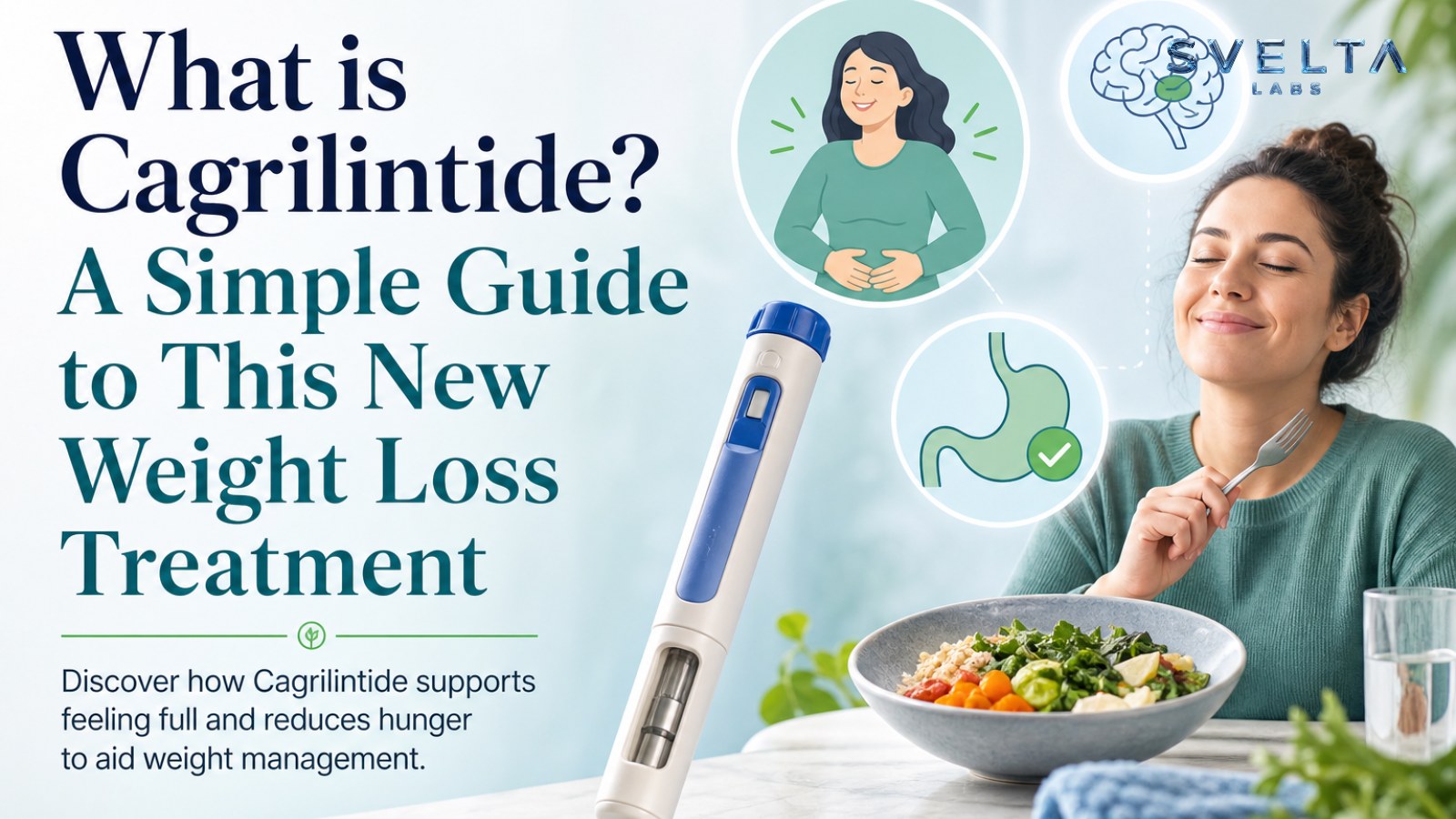
What is cagrilintide, and why is it being studied for weight management? It is a long-acting amylin analogue: an investigational compound designed to imitate a hormone involved in appetite regulation. Research findings should be distinguished from an approved treatment available through routine care.
What is Cagrilintide?
Cagrilintide is a man-made version of a natural hormone called amylin. Amylin is produced in the body alongside insulin and helps regulate appetite and digestion. Scientists have created Cagrilintide to mimic these effects and support weight management.
How amylin signalling relates to appetite
Amylin-related signalling helps regulate fullness and food intake. Cagrilintide research examines whether acting on this pathway can support weight reduction. A biological mechanism is an explanation for studying a compound, rather than a guarantee of benefit for an individual.
How is cagrilintide studied?
Clinical studies have investigated cagrilintide as a once-weekly injection, alone and with semaglutide. These are supervised study regimens, not instructions for using research products.
CagriSema trial results: combination versus single agents
CagriSema combines cagrilintide with the GLP-1 receptor agonist semaglutide. In the 68-week REDEFINE 1 trial, mean weight change was about −20.4% with the combination versus −3.0% with placebo under the treatment-policy analysis, which includes outcomes regardless of adherence. The trial also included single-agent comparison groups. These population averages should not be presented as a personal forecast. See the original REDEFINE 1 publication.
Cagrilintide versus GLP-1 receptor agonists
Cagrilintide focuses on amylin signalling, while semaglutide targets GLP-1 receptors. Combining pathways is a research strategy, but it does not make arbitrary combinations of peptides interchangeable with the trial formulation or establish that they are safe.
Cagrilintide side effects and approval status
Digestive adverse effects, including nausea, were a significant consideration in the trials. Tolerability, longer-term safety and the balance of benefits and harms remain essential parts of evaluating an investigational treatment.
Novo Nordisk has reported a US application for CagriSema. An application or anticipated decision is not an approval; the manufacturer announcement should not be used as evidence that cagrilintide can already be prescribed routinely.
Reading future cagrilintide research
When comparing headlines, check whether a result concerns cagrilintide alone or CagriSema, how long the study ran and which analysis produced the quoted percentage. Those details explain why two reports of the same trial may give different figures.
This is research education, not treatment advice. Research-use products are not substitutes for licensed medicines or supervised clinical-trial material.
For Svelta Labs product education, research-use categories, and current storefront information, visit https://sveltalabs.com.
Sources
NEJM: REDEFINE 1 trial of cagrilintide–semaglutide: https://www.nejm.org/doi/full/10.1056/NEJMoa2502081.
Novo Nordisk: US CagriSema application announcement: https://www.novonordisk.com/news-and-media/news-and-ir-materials/news-details.html?id=916470.
Novo Nordisk: Q2 2026 investor presentation and development pipeline: https://www.novonordisk.com/content/dam/nncorp/global/en/investors/pdfs/financial-results/2026/Q2-2026-Full%20presentation.pdf.